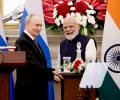
India and Russia have called for an uncompromising global fight against terrorism without hidden agendas and double standards. Prime Minister Narendra Modi asserted that the menace is a direct attack on the values of humanity.
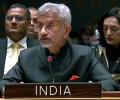
India abstained on two UN General Assembly resolutions calling for a de-escalation, an early cessation of hostilities and a peaceful resolution of the war against Ukraine. The resolutions were adopted on the third anniversary of the Russia-Ukraine conflict, with the UN Secretary General stressing that the war in Ukraine stands as a grave threat to the peace and security of Europe and the core principles of the United Nations.
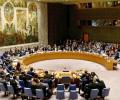
Pakistan was waiting for an opportunity to bring the Jammu and Kashmir issue to the global agenda and resorted to the terrorism route to provoke India, observes Ambassador T P Sreenivasan.
India told the UN Security Council that it calls for a pragmatic engagement with the Taliban, underlining that a focus on only punitive measures will ensure a 'business as usual' approach.
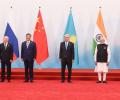
The Shanghai Cooperation Organisation (SCO) strongly condemned the Pahalgam terror attack and concurred with India's position that 'double standards' in the fight against terrorism are unacceptable.

Earlier in the day, the ministry of external affairs "strongly advised" Indians to avoid travel to Iran until further notice, amid rising tensions and protests in the Islamic Republic.
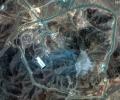
Iran on Sunday vowed to avenge the United States bombing of three of its major nuclear facilities saying the American strikes will have 'everlasting consequences'.

Left parties on Saturday denounced the United States for attacking Venezuela and capturing its President Nicholas Maduro, with Communist Party of India-Marxist general secretary M A Baby terming the nighttime military action an 'act of international terrorism by US-led imperialism'.

The United Nations Charter was signed on June 26 1945, in San Francisco.

Karex, the Malaysian company that makes roughly one in five of the world's condoms -- about five billion a year, supplying Durex and Trojan among others -- announced this week that it is raising prices by up to 30 percent. The reason is the Strait of Hormuz.
Pakistan on Wednesday summoned the Indian charg d'affaires and lodged a strong protest against the Indian military strikes.

The 193-member General Assembly adopted the draft resolution, put forward by Ukraine and its supporters, titled 'Principles of the Charter of the United Nations underlying a comprehensive, just and lasting peace in Ukraine'.

'To suddenly give the impression of taking a position that is hostile to Iran, or, at least, not friendly to Iran, is not a good thing.'
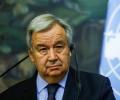
Guterres urged members of the Security Council to press to avert a humanitarian catastrophe and appealed for a humanitarian ceasefire to be declared.

Exercising self-defence is a nation's primary right when a situation demands 'immediate and proportionate action' and applies also to attacks by non-state actors, India told a United Nations meeting, highlighting several proxy cross-border and state-supported terrorist attacks like the 26/11 Mumbai assault the country was subjected to from its neighbour.

India was among the countries not present in Davos when US President Donald Trump unveiled his "Board of Peace" that seeks to work towards bringing lasting peace to Gaza and possibly resolve global conflicts. India is yet to take a call on it, people familiar with the matter said when asked about Trump's invite to PM Modi.

India has stated it will wait for the outcome of the elections in Bangladesh and the resulting mandate before addressing any existing issues. The country also affirmed its support for free, fair, inclusive, and credible elections in Bangladesh.
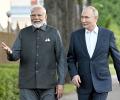
Ahead of Modi-Putin talks, the US called upon India to make it clear to Russia that any resolution of the Ukraine conflict must respect the United Nations charter and Ukraine's territorial integrity and sovereignty.

Dar recalled that when he met US Secretary of State Marco Rubio in July and asked about dialogue with India, the top US diplomat clarified that India has maintained it is a "bilateral issue."

"The responsibilities of member states must be assumed by member states and let's not make the UN the scapegoat of the failures or of the negative actions that are committed by member states," he said.

'While on the one hand, terrorism continues to be a serious threat to global peace and security, on the other hand, areas such as cyber, maritime and space, are emerging as new theatres of conflict'
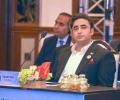
Bhutto, who served as the Foreign Minister earlier, addressed a briefing at the UN Headquarters in New York and sought reconciliation with India, making a plea for talks and Intel sharing between the two neighbours.

Ukrainian President Volodymyr Zelenskyy told the United Nations Security Council that 'we have to prepare' the second peace summit to end the Russia-Ukraine war 'altogether' and he has invited India and other countries to join the peace process.

Trump's 'Board of Peace' is being projected by Washington, DC as a new international body to usher in peace and stability in Gaza and beyond, triggering speculation that it could throw a challenge to the United Nations.
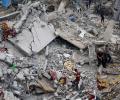
The resolution, sponsored among others by Algeria, Bahrain, Iraq, Kuwait, Oman, Qatar, Saudi Arabia, United Arab Emirates and Palestine, demanded an immediate humanitarian ceasefire in Gaza and reiterated its demand that all parties comply with their obligations under international law, "notably with regard to the protection of civilians."

Pakistan's former foreign minister Bilawal Bhutto-Zardari on Monday said his country will go to war if India denies Islamabad its fair share of water under the Indus Waters Treaty (IWT).

Iran is fighting a different war: Older, slower, and in some ways more dangerous. Iran doesn't need to shoot down an F/A-18. It only needs to make the Strait of Hormuz feel dangerous long enough for insurance markets, shipping companies, and oil futures traders to do the rest. Prem Panicker continues his must-read daily blog on the war in the Middle East.

Raising the Kashmir issue at the UN, China has told the General Assembly that the "dispute" should be peacefully and properly addressed in accordance with the UN Charter, Security Council resolutions and the bilateral agreement. China, a close ally of Pakistan, also stressed that no actions should be taken that would unilaterally change the "status quo".
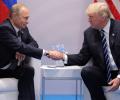
The US ended up abstaining from the vote for its own resolution at the General Assembly after several amendments were passed ahead of the vote to strengthen the language against Russia and reaffirm Ukraine's territorial integrity.

China Thursday offered to play a 'constructive role' to ease tension between Pakistan and Iran following their missile strikes against each other over the last two days and asked the two countries to 'exercise restraint and calmness and avoid escalation'.

Prime Minister Narendra Modi condemned the violation of Qatar's sovereignty following Israeli air strikes on Doha, targeting Hamas leaders. He conveyed India's deep concern to the Emir of Qatar and reiterated support for peace and stability in the region.

We have nothing to gain by raising our concerns internationally as our narrative has got entangled with several controversial concepts in the United Nations, asserts Ambassador T N Sreenivasan.
In an interaction with PTI Videos in New Delhi, Iran's deputy chief of mission to India Mohammad Javad Hosseini also said Americans should "put pressure" and bring the other side back to the negotiating table.

Emphasising the importance of sustaining food and energy security, the G20 leaders called for the "cessation of military destruction or other attacks on relevant infrastructure".

The 193-member general assembly voted overwhelmingly on Wednesday to condemn Russia's "illegal so-called referendums in regions within the internationally recognised borders of Ukraine and the attempted illegal annexation of the Donetsk, Kherson, Luhansk, and Zaporizhzhia regions of Ukraine, following the organisation of the above-mentioned referendums".

The 193-member UN General Assembly on Thursday voted to adopt a draft resolution moved by the US to suspend Russia from the Geneva-based United Nations Human Rights Council (UNHRC) over allegations that Russian soldiers killed civilians while retreating from towns near the Ukrainian capital Kyiv.

AIMIM chief Asaduddin Owaisi slammed Pakistani politician Bilawal Bhutto-Zardari for his "blood would flow in rivers" remark and called former cricketer Shahid Afridi a "joker" for his comment on the Pahalgam terror attack. Owaisi also supported India's decision to suspend the Indus Waters Treaty and called for Pakistan to be placed on the FATF grey list. He also advocated for cyber attacks against Pakistan.

Jaishankar said the world has experienced its consequences in terms of higher costs and shortages of foodgrains and fertilizers and fuel.


A special United Nations envoy to Crimea, who was threatened by 10 to 15 armed men, is safe and will return to Ukrainian capital Kiev to continue his mission, the United Nations has said.
